Long Beach and San Pedro
The richest ground in Los Angeles, and the cordon starts where its fences stop.
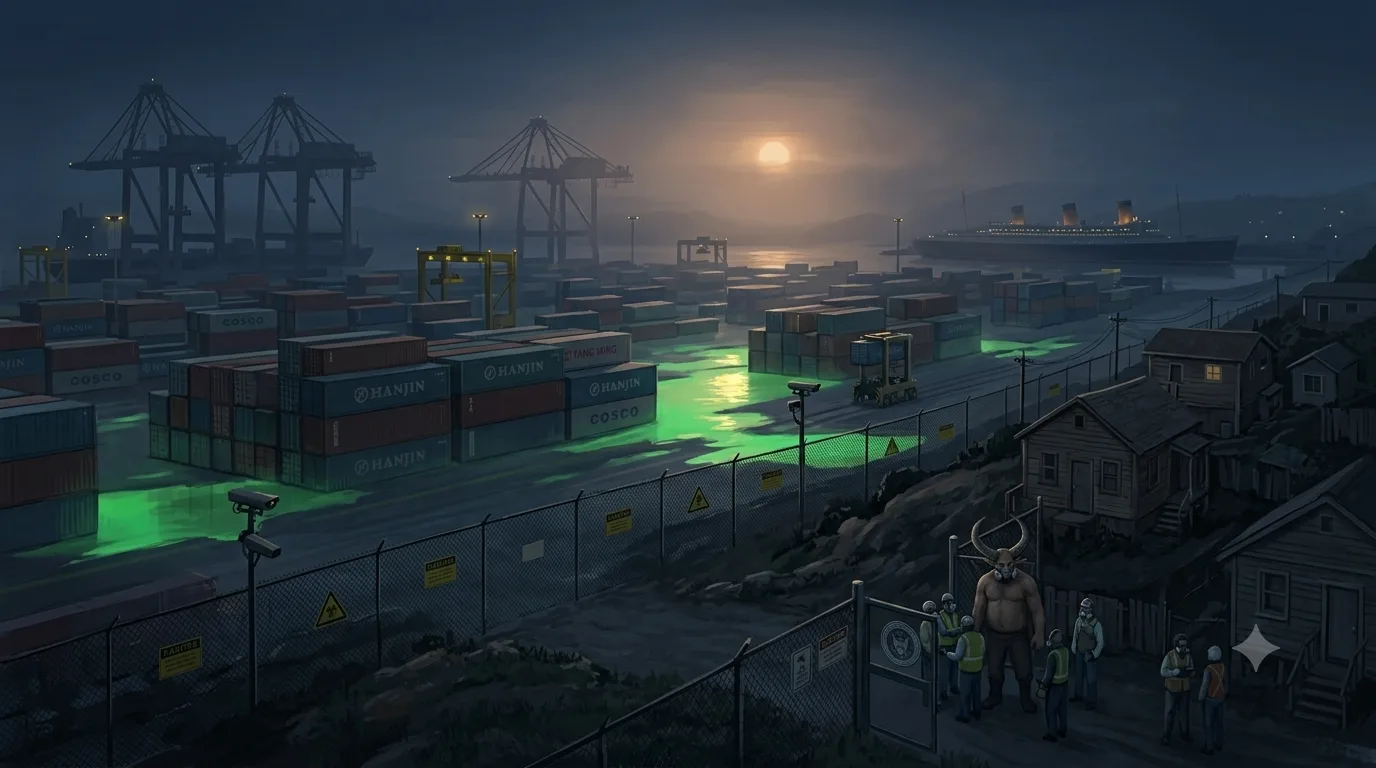
Two harbor towns facing each other across the water, and between them the largest port complex in North America. Everything the city eats comes through here, so the Corporate Court guarantees the place, and it is the only ground in Los Angeles where several megacorporations hold sovereign parcels side by side and none of them will start anything.
El Infierno is next door on both sides, and that name covers more ground than people expect. The cordon runs about a hundred miles, from the Santa Monica pier down to San Onofre: the LA beach cities, the whole Orange County shoreline past Newport and Laguna, and on down to the bluff the casks were sitting on when they went. It follows the poison, and the poison started at the south end and came north on the current. So the fence does not end at the county line, because the contamination didn't. It ends at the source. The harbor sits in the middle of all that as the one gap the wire never crosses, and why that is takes the rest of this page.
And at the far end it runs out of coast to cover: south of San Onofre is the seventeen miles of empty buffer across old Pendleton, and south of that is San Diego, sealed since 2050.
The Green Tide came up that coast in 2056 and the harbor was the one thing on it anybody managed to defend: what got past the gates went into the channels, the slips and the flats behind the breakwater, at a fraction of what the open shore took. So the wealth and the ruin are not in different districts here. They share a fence, and in places they share a gate.
Terminal Island is the crown jewel: an actual island in the middle of the complex, container terminals leased one at a time, each one legally another country. Reachable by two bridges and nothing else. San Pedro climbs the hill on the west side: a fishing town for a century and a half, Croatian and Italian families who have been on the same streets for five generations, and the harbor's memory lives there rather than in any archive. Wilmington sits inland of the channel on top of one of the biggest oil fields in the country, so the refineries are there and the air has never been anybody's priority. Long Beach proper is the east side: the airport that handles the port's cargo, the older downtown, and the Queen Mary at her berth.
Elevation decided who got the worst of it, the same way Palos Verdes decided it for the beach cities. Terminal Island is fill at sea level and Wilmington is flat, low ground on the inland side of the channel, so both took the sediment in 2056 and the wave in 2058. San Pedro is on marine terraces above its own waterfront: the bluff at Point Fermin stands about a hundred feet over the water, and the Palos Verdes hills behind the town climb past a thousand. The poison is in the harbor the town looks down on rather than in the town.
The wire agrees with the contour here. The cordon takes the strip along the water and stops at the foot of the terraces, so a house up by Averill Park looks down on fenced ground without being behind anything. What the hill bought was never being the problem: no sediment, no wave, and air that depends on the wind like everybody else's. That is most of the answer to why five generations of the same families are still on those streets.
Nobody lives inside the cordon, because that is what a cordon is. The people live against it: San Pedro on its terraces, Wilmington and Long Beach behind the defended perimeter, a million of them within a mile of the wire, and most of them work the port it protects or the fenced ground it encloses.
The nine days#
The harbor came through because it was defended. The nine days it took the plume to come up the coast from San Onofre are the reason the port is a going concern while the beach three miles west of it is not. The inshore current in the bight runs north at about walking pace, so everybody who mattered knew what was coming and roughly when. Nine days is enough time to close things that already exist and nowhere near enough to build anything.
What got defended was a line, and it has two ends worth knowing. Point Fermin in the west, where the peninsula drops off its shelf into the water, and the San Gabriel River in the east. Everything between them held: the port, Terminal Island, the Wilmington flats, the Long Beach shore and the Dominguez ground behind it. Everything outside them is El Infierno, and the change is abrupt in both directions. The cordon wire starts at the headland on one side and at the riverbank on the other, and on the map those are the two places the green stops.
Neither end was chosen for being defensible. They are where the things that already existed happened to be: the breakwater's western root anchors on Fermin, and the river is a concrete channel eighty feet across with levees on both banks and every crossing already gated. The defense ran between two fences somebody else had built.
San Pedro Bay has been enclosed since the 1900s by eight miles of federal rubble mound with exactly three gaps in it: Angels Gate, Queens Gate and the east end. A consortium of the companies holding parcels inside spent those nine days narrowing all three, with quarry rock off barges, ships deliberately sunk in the channels, silt curtains, and every crane on the coast already standing where it was needed. They also put mages on the gates, in numbers this city had never seen before and has not seen since: water spirits holding the exchange down at three gaps for a fortnight while the rock went in, worked in shifts by every talent the corporations could hire or compel, at a cost nobody has ever published. People who were here still call it the fortnight the harbor had spirits in it, and it remains the only time magic has been used at the scale of civil engineering on this coast.
It worked well enough to keep the harbor off the cordon maps. Perhaps a tenth of the dose came inside the breakwater compared with the open shore, which is the difference between a contamination problem that dredging and certification can manage and one that ends a port. Sediment still came inside on the first tide, the 2058 wave still sent a surge through the basin two years later, and the subsidence pumps have been injecting harbor water into the ground underneath Long Beach ever since. There was no second nine days in 2058, and the harbor did not need one. The wave came off the Palos Verdes shelf, west of the point, and the peninsula that had failed to stop a current coming north stood square between the landslide and the bay: the beach cities faced the source and took the wall, the harbor stood behind the hill and took a surge. It topped nothing, stirred the sediment, and funnelled up the river mouth as the bore that dirtied the channel. Fifteen minutes of warning would have bought nothing anyway, but nobody had to find out.
The beach cities had fifteen miles of open shoreline, no breakwater and no gates, and no amount of money shuts an open coast in nine days. That, rather than anybody deciding those streets were worth less, is why Manhattan, Hermosa and Redondo sit behind the same wire as the refineries while a port three miles away runs to schedule. It is also a distinction people in Wilmington will make for you unprompted and without much patience, because what those nine days proved is that ground could be protected when somebody was willing to pay for it. Wilmington came through because it stood behind rock that was bought for the terminals, nobody spent a shift of those nine days on its account, and what the town got afterwards was the pumps, putting poisoned harbor water into the ground under it on a schedule ever since. Saved by arithmetic, and never once asked.
What the crew knows#
-
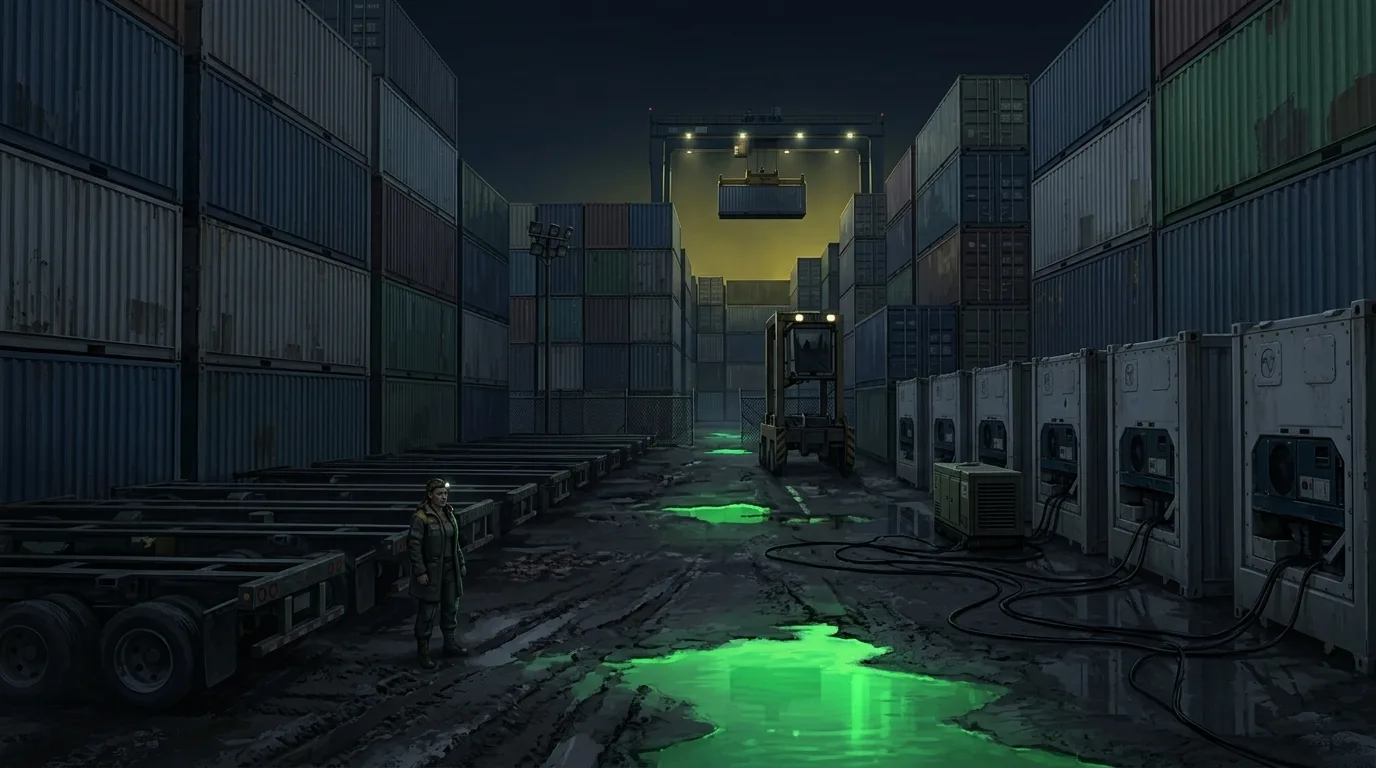
Nobody shoots inside a working terminal, and everybody shoots in the yards. On leased ground the guarantee holds: violence costs every corporation money, security is restrained and thorough and writing everything down, and a round fired on a terminal is a Corporate Court incident rather than a police matter, which is worse for all concerned and is why it doesn't happen. What the rule actually does is push the violence a few hundred meters outward. Overflow yards, empty stacks, chassis rows, the container-repair lines, the laid-up ground behind the old Navy mole: nobody's sovereign soil, no cameras worth the name, forty-foot steel walls in every direction and no line of sight longer than a lane. That is where the harbor settles its arguments, most nights, and it is the best terrain in the campaign for a firefight.
-
The people shooting are rarely corporations. The parties to a diversion are crews, brokers, bent clerks and each other. A terminal doesn't care who wins a fight in an overflow yard over a box that has already been written off, which is precisely why the fight is allowed to happen there.
-
Terminal Island terminals are separate countries with separate rules. Crossing from one lease to the next can mean different law, different search powers, and a different company's opinion of you. The bridges are the chokepoints and both are watched.
-
The Queen Mary is neutral ground: hotel, bar, and the one table in the harbor where three corporations will sit down together. It is also a ship, which means one gangway and a lot of interior nobody has mapped since before the plague.
-
Longshore work is organized, hereditary, and the union is older than any corporation in the harbor. They are not a gang and should never be played as one. They know what's in the boxes.
-
Cargo diversion is the harbor's real economy. A container that never reaches its manifest destination is worth more than anything the crew could steal from a house, and the people who do it professionally have been doing it for generations.
-
Air is a daily calculation. On a bad wind the outdoor work stops and everyone masks up, including the corporate security.
-
Long Beach is a city that stays above the sea because somebody keeps pumping. The oil field under it sank the harbor district by up to twenty-nine feet before anyone worked out that injecting water back in would stop it, and that injection has been running ever since. The Tide poisoned the water it injects. Nobody says the program is failing; everyone can see the streets.
-
The airport is gone, not flooded, just finished. Brackish subgrade, heaved runways, and no operator willing to site a fuel farm on contaminated ground. The port's freight goes over the docks and onto the rail corridor, as it did before there was ever a field there.
-
The clearance certificate is the document that matters here. Every container leaving gets one, nobody inland accepts a box without one, and a clean certificate on a dirty box sells for more than the box. If a job in this district involves paper, it is probably this paper.
-
The cordon runs a hundred miles and the harbor is the one gap in it. The pier down to San Onofre, and then the buffer and the sealed city; the wire comes down to the water on the West Basin and does not pick up again until the far side of the river mouth. Anything crossing salt water into Southern California crosses through that gap, so every megacorporation is polite in the harbor and nowhere else.
-
Somebody was warned nine days out, and it wasn't the residents. You cannot close three gates ahead of a plume without knowing the plume is coming. There is a cost-sharing agreement for that fortnight, it names who paid what share, and therefore it names who was told. Nobody has produced it.
-
The sunken ships are still in the channels. Some were refloated, most were cut up in place, and a few are simply charted obstructions now. Old hulls full of contaminated silt, in water nobody swims in, at known coordinates, which is a cache, a hazard and a landmark depending on who you ask.
Getting in#
The towns are open city: drive in, walk in, or take the A Line down from Downtown, which everybody still calls the Blue Line because the trains are still blue. The cordon around the poisoned ground is fencing, signage and a patrol schedule, and it leaks in a hundred places.
The port is the opposite: no wall, but a credential, a manifest, a berth assignment and a reason. Get hired, get subcontracted, or arrive as somebody's paperwork. Terminal Island needs all of that plus a bridge crossing that gets logged both ways.
Canon reference: Long Beach