Century City
A studio's parking lot, subdivided into countries. No through streets, no published map of who owns which lobby, and the border is a lobby floor.
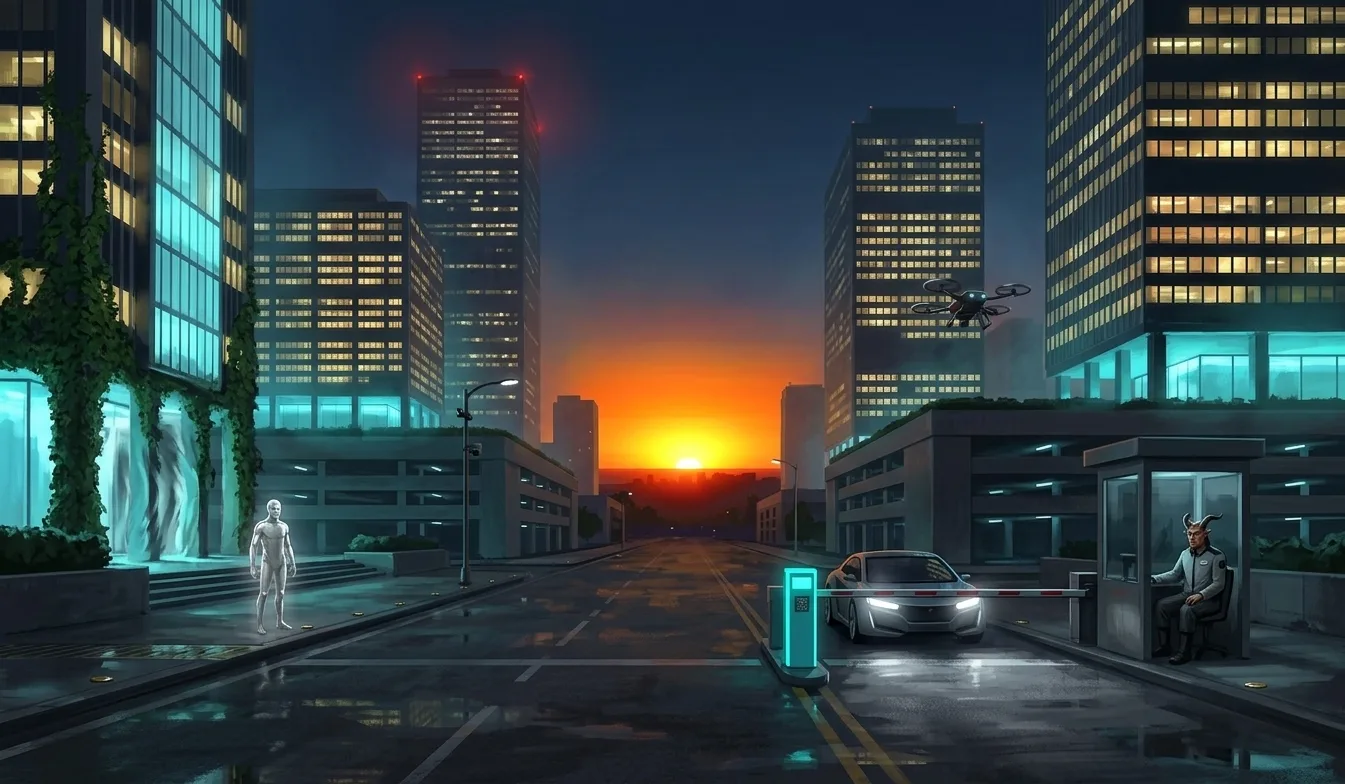
A hundred and eighty acres between Santa Monica Boulevard and Pico, and it was a back lot. Twentieth Century Fox sold the land in 1961 and the name is not a flourish: this is a film studio's overflow ground, surveyed into blocks and sold up. Everything about how the place works follows from that, because a back lot has no street grid to inherit and nobody ever gave it one.
So: Avenue of the Stars, Century Park East, Century Park West, Constellation. Four wide boulevards, and almost nothing crosses between them. The towers sit back on plazas, the plazas sit on top of the parking, and the parking is where the buildings actually meet the city: three and four levels of it under every address, each ramp gated, each gate belonging to one building.
You cannot walk through Century City by accident. Every other district in Los Angeles is somewhere you pass through on the way to something else. Here there is no through route, on foot or in a car, and there never was. A corporation wanting extraterritoriality made physical did not have to negotiate for it. It bought a parking lot with the geometry already in place.
Nobody holds Century City. There is no landlord of the district and never has been: a back lot sold up in parcels stays parcels. Twenty-odd buildings, fewer owners than buildings because several hold more than one, and no published map of which lobby belongs to whom. Ask how many countries are inside a hundred and eighty acres and you will not get a number, from anybody, including the people who work here.
It's one of the city's arcology clusters, the same species of ground as Downtown's Bunker Hill or the studio arcology cluster in Studio City and Burbank: see Los Angeles for the pattern.
A few owners are worth knowing before a job rather than during one. Fox Plaza, thirty-four stories and the one everybody can draw from memory, is Ares', and Knight Errant's regional contracts desk is on it, so many jobs in this city start with a lift ride. The north tower of Century Plaza is Mitsuhama's, held through the entertainment business on the same content-security argument that gets them the Studio City and Burbank lots: the rights and the archives are in there, the screening at that lobby is the best on the continent and it points both ways, and the correct number of runs to attempt inside it is zero. Its twin next door is ordinary title and ordinary security, which is the kind of detail that decides a job. The mall and the towers hanging off it are one retail freeholder and the softest boundary in the district. The rest is entertainment law firms, arbitration houses, and a couple whose freeholders are holding companies that resolve to other holding companies.
Cross Avenue of the Stars and you have not gone anywhere. Walk into the lobby on the other side of it and you have changed countries, and there is no sign either way.
The corporations left Downtown for these towers decades ago and never went back. Bunker Hill kept the registered addresses and the authority. Century City got the work: the regional offices, the contracts desks, and the people who can actually decide something about Los Angeles. If a job in this city has a signature on it, it was signed past a lobby desk in this district.
It has water, and not by the hour, which is the detail that matters most: a commercial supply contract, billed by volume to a corporate counterparty, the way Pueblo sells to any other business. The fountains in the plazas run all day. Nobody who works in the towers lives here, so every one of them goes home at seven to a building with a roof tank and a schedule, and the fountains are the most resented object in the city.
What the crew knows#
- The plazas are public and the lobbies are not, and the line is the lobby floor. Stand outside all day; nobody minds. Cross the threshold and you are in another country under the Business Recognition Accords. Armed, that isn't trespass, it's an armed incursion, and the answer is detention on their ground with a lawyer instead of a cop. See getting around.
- There is no through route, and it cuts both ways. A vehicle that turns in has to come out the way it went in: very bad for a getaway, and very good for a meet nobody could have followed you to.
- The parking is the real ground floor. It is the only place a vehicle gets within a hundred meters of a lobby, every ramp is gated and named, and a crew with a reason at the gate has solved most of the problem already.
- Knight Errant's regional office is here, so response times are single minutes rather than the twenty you can count on anywhere else. Nothing here runs long. Plan for the first response, not the third.
- What's valuable here is paper, not product. Contracts, options, rights, settlements, arbitration files. Nothing in these towers weighs anything, so a job here is a data job or it has come to the wrong district.
- The mall is the way in. Its levels are open to anybody, they connect to two of the towers, and they are inside the perimeter. Everybody knows this, including the people watching it.
- The staff commute, and the crew can be staff. Cleaning, catering, plant maintenance, courier, ramp. Almost all of it arrives from Koreatown and through Union Station, on somebody else's badge, twice a day, on a schedule anybody can read.
- You are on camera continuously and the footage cannot be obtained. It belongs to whichever freeholder's frontage you were standing on, and that freeholder is a jurisdiction, so there is nobody to subpoena and no court with standing to hear it. It also means no single party can watch you cross the district: every frontage has its own cameras and its own owner, and none of them share a feed.
- Two of the towers are held by holding companies, and reading up the chain is a legitimate job somebody will pay for. Whoever is at the top of it is not on the letterhead, and the crew is not the first outfit to go looking.
Getting in#
By car to a gated ramp with a name, which is how people who belong here do it. On foot through the mall, like everybody else. Or on somebody's appointment, the only one of the three that gets you past a lobby.
The plazas need nothing at all. Fountains, restaurants, benches, tables outside: open, watched, and perfectly fine to sit in for an hour. A face can do most of a job from a plaza table without ever crossing a threshold, and that is usually the right plan.
Delivery is the other door and it is the busy one: loading levels under every tower, running from before six, with more vehicles arriving than anybody checks properly. The manifest matters more than the van.